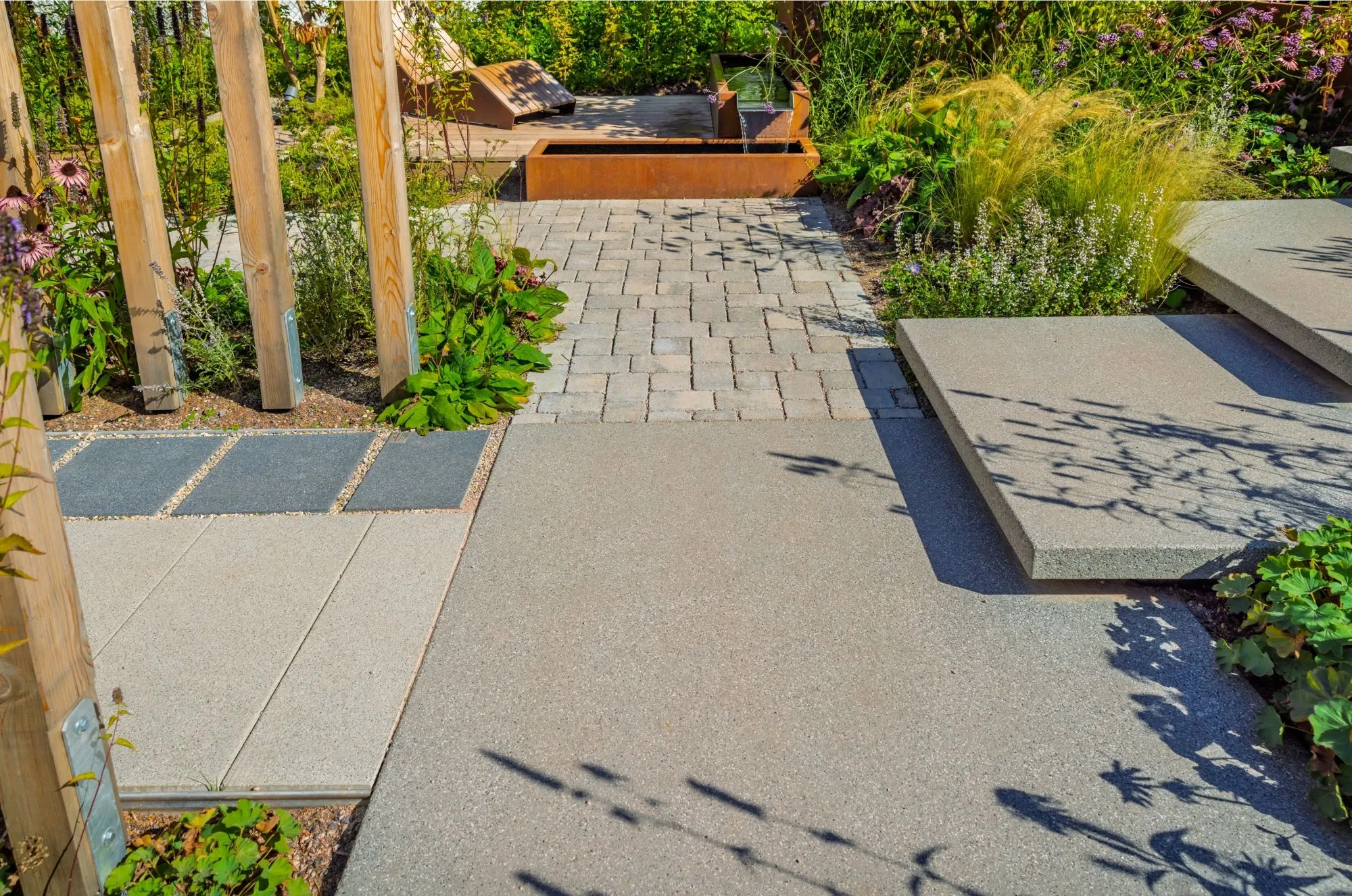
Natural stone and manufactured concrete pavers both create durable patios, but they differ in appearance, installation demands, repairability, and cost predictability. Stone provides individual variation and a more organic finish, while concrete pavers offer consistent dimensions and standardized installation systems. Vanskyline Construction compares both options according to the yard, patio use, and maintenance expectations.
Choosing Between Natural Stone and Pavers for a Vancouver Patio
Natural stone is generally the better fit when authentic material variation is a priority and the project budget allows for additional selection, cutting, and fitting. Concrete pavers are often more practical when consistent elevations, predictable installation, or straightforward repairs matter more.
The decision also depends on the ground beneath the patio. Soft soil, filled areas, poor drainage, and active tree roots can affect either surface. Dry-laid materials are easier to reset after localized movement, but recurring settlement will continue until the underlying cause is corrected.
Neither option automatically performs better in Vancouver rain. Excavation, base preparation, edge support, surface slope, and runoff planning have more influence on long-term stability than the finish material alone.
How Each Patio Surface Performs in Local Yard Conditions
Vancouver patios experience extended wet periods, slow drying in shaded yards, organic debris, and occasional freeze-thaw movement. The selected product must suit exterior exposure and work with an installation system designed for the property.
Professional hardscaping for Vancouver properties treats the patio as a complete assembly. The visible surface depends on the subgrade, aggregate base, bedding layer, joints, perimeter restraint, and finished elevations beneath it.
Natural Stone Patio Strengths and Limits
Natural stone provides colour, texture, veining, and edge variation that manufactured products do not reproduce exactly. It works particularly well with established gardens, natural retaining features, and homes where a highly uniform surface would feel out of place.
The term “natural stone” does not identify how a product will perform. Granite, slate, sandstone, limestone, and other stones have different absorption rates, strengths, abrasion resistance, and responses to freezing conditions. Suitability should be confirmed through product-specific exterior-use, absorption, freeze-thaw, thickness, and finish information from the supplier.
Surface finish also affects wet traction. Cleft, flamed, or bush-hammered finishes generally provide more texture than honed or polished surfaces. However, roughness is not a substitute for verified wet-surface performance, especially on steps, slopes, and routes used throughout the year.
Natural stone can be dry-laid over a prepared aggregate base or installed as part of a rigid mortared assembly. Dry-laid construction accommodates minor movement and allows individual stones to be lifted. Mortared installation provides a more rigid surface but requires an appropriate supporting slab, drainage detailing, compatible setting materials, and more involved repairs.
Irregular flagstone requires individual fitting and base adjustment because the pieces differ in shape and thickness. Uneven support can cause rocking, raised edges, cracking, or movement underfoot. Calibrated stone has more consistent dimensions, which reduces some installation complexity without removing the natural colour and texture variation.
Maintenance depends on porosity, finish, joints, shade, and exposure to food or organic debris. Some stones benefit from a compatible penetrating sealer, while others are better left untreated. A sealer should not be applied without confirming that it suits the stone and will not create an unwanted colour change or reduce traction.
Paver Patio Strengths and Limits
Manufactured concrete pavers provide controlled dimensions, consistent thickness, and defined product specifications. These characteristics simplify joint spacing, edge restraint, and elevation control around doorways, steps, and connecting walkways.
Professional paving stone installation requires excavation and base depths suited to the soil, drainage conditions, and expected loads. Consistent units make installation more predictable, but pavers will still settle if the subgrade remains unstable or the supporting layers are inadequate.
Dry-laid interlocking pavers are usually the more forgiving option when localized repairs or future underground access are expected. Individual units can be removed, the affected base corrected, and the same surface reinstated. This advantage is reduced when pavers are mortared, bonded to a rigid surface, restrained by damaged edges, or no longer available.
Keeping spare pavers from the original production batch improves replacement matching. Units purchased years later can differ because of production changes, weathering, or discontinued colours.
Standard interlocking pavers are not automatically permeable. Conventional installations carry water across the surface through finished grading. Permeable systems use compatible units, open joints, graded aggregate layers, and a base designed to temporarily store or move water.
Permeable pavers are not suitable for every wet yard. Low-infiltration soil, limited excavation depth, high sediment exposure, or the absence of a workable overflow route can complicate the system. Joint aggregate and surface openings also require inspection and debris control to maintain infiltration.
Cost, Installation, and Repair Tradeoffs
Natural stone and paver prices should be compared using the same excavation, base, drainage, access, and edge requirements. A lower material price does not produce a lower completed cost if the quote excludes necessary preparation.
| Factor | Natural Stone | Manufactured Concrete Pavers |
| Material pricing | Varies by stone type, source, thickness, finish, and availability | Available across broad price ranges with more standardized unit pricing |
| Installation labour | Higher for irregular shapes, variable thickness, sorting, and custom fitting | More predictable because units have controlled dimensions |
| Material waste | Cutting and fitting irregular pieces can increase waste | Modular sizing generally makes quantities easier to calculate |
| Exterior suitability | Must be confirmed for the specific stone and finish | Product specifications usually identify intended exterior applications |
| Installation options | Dry-laid or installed in a rigid mortared assembly | Commonly dry-laid as an interlocking system, with other systems available for specific products |
| Settlement repair | Dry-laid stone can be reset, while mortared stone is harder to repair selectively | Dry-laid units are generally easier to remove and reinstall |
| Replacement matching | Natural variation and future availability can make matching difficult | Spare units help, but later production batches can differ |
| Drainage systems | Surface drainage or a purpose-designed permeable assembly | Conventional surface-draining and purpose-built permeable systems are available |
| Ongoing costs | Could include compatible sealing, joint care, resetting, and specialized cleaning | Could include joint-material replacement, resetting, cleaning, and replacement units |
| Cost predictability | Lower when pieces require extensive fitting or site adjustment | Generally higher once the product and installation scope are confirmed |
The more affordable option depends on the complete installed scope and expected upkeep. Quotes should identify base construction, drainage work, edge restraint, cutting, joint materials, and repair provisions so the comparison reflects equivalent work.
 When Natural Stone Is the Better Patio Choice
Natural stone is the stronger choice when the material itself is central to the finished property. Its individual colour and texture suit patios intended to connect with existing stonework, mature gardens, natural slopes, or traditional architecture.
The additional cost and installation effort are easier to justify when a suitable exterior stone is available in the required quantity, thickness, and finish. Homeowners should also accept that replacement pieces and joints will not appear perfectly uniform.
Around an outdoor kitchen, stone selection should account for porosity, stain resistance, grease exposure, cleaning requirements, and sealer compatibility. Cabinetry, counters, and appliances still require suitable structural support independent of the patio finish.
Natural stone can surround a compliant fire feature, but patio stone should not automatically be used inside the firebox. Materials exposed to direct flame require the specified liner, clearances, and manufacturer-approved construction. Non-combustibility alone does not confirm that a stone is suitable for intense direct heat. Natural stone is less practical when strict cost control, uniform elevations, rapid installation, or easy replacement matching are the primary requirements.
When Pavers Are the Better Patio Choice
Pavers are the stronger choice when consistent dimensions, defined specifications, and modular repairs are priorities. They work well around doorways, steps, borders, and other locations where controlled surface elevations simplify installation.
They are especially practical where future utility access or localized settlement is possible. Dry-laid units allow the affected area to be opened and reinstated without demolishing the entire patio.
Pavers are not automatically better for a wet yard, but they provide clearly defined drainage options. Conventional systems suit properties where runoff can move safely across the surface. Permeable systems become relevant when the soil, excavation depth, sediment exposure, and overflow plan support infiltration or temporary water storage.
Around outdoor kitchens, replaceable units offer an advantage if a paver becomes stained or damaged. The base and any dedicated footings must still support cabinetry, counters, appliances, and concentrated loads.
A filled hot tub creates substantial weight, so a standard patio base should not be assumed adequate. Structural support, equipment access, runoff, and electrical clearances must be resolved separately. Pavers can simplify future access to underground services, while the selected finish must provide suitable wet traction around the tub.
Ordinary concrete patio pavers should not form the combustion chamber of a fire pit unless the system manufacturer specifically approves that use. A compliant fire feature requires the specified liner, heat-rated materials, and clearances from surrounding construction.
Pavers are generally easier to reset or replace, but that does not make them maintenance-free. Joint condition, edge stability, shade, staining, and organic debris still affect upkeep. Natural stone could require less routine joint attention in some installations, so repairability and maintenance should be evaluated separately.
How Vanskyline Construction Plans Patio Materials Around the Yard
Vanskyline Construction plans custom patios in Vancouver by matching the surface material and installation method to the property. The company installs natural stone and concrete pavers within complete landscape construction projects.
Its CMHA-certified hardscape installers review intended loads, soil stability, drainage direction, access, finished elevations, and connections to surrounding features. Product suitability, surface finish, setting method, edge details, and replacement-material planning are confirmed before installation begins.
The managed construction process includes layout planning, excavation, base installation, material placement, joint finishing, and cleanup. Final checks address surface alignment, edge stability, transitions, joint completion, finished elevations, and runoff direction.
Homeowners can review Vanskyline Construction’s Vancouver landscape construction services to see how patios integrate with broader yard projects.
A patio consultation provides an opportunity to compare suitable materials, installation systems, and project requirements for the property.